
USS Gerald Ford, courtesy of Wikimedia Commons
More respondents now say that the US-Israeli relationship is a net negative than a net positive. Declining support for Israel is likely accelerating.
The number of respondents who said they support airstrikes on behalf of Israel fell from 37% in July, 2025, to 27.9%. This drop was largely driven by Republicans.
The 27.5% who support striking Iran are outnumbered by the 52.2% who oppose it.
A US strike on Iran could cost Republicans 4.7% of the white vote in the midterms, including 13.8% of white voters age 18-29.
48.3% of respondents said they can think of a concrete example of Israel hurting America interests, up from 41.9% in 2025 and 29.3% in 2024. Only 29.3% claim they can think of an example of Israel aiding American interests.
By David M. Zsutty
In January 2024, the Homeland Institute ran a poll on non-interventionism and related topics in response to the Gaza crisis, and again in July, 2025 in response to the Twelve Day War. As tensions mounted over a possible US strike on Iran in early 2026, we ran another poll on non-interventionism to track how public opinion is evolving.
We polled 801 respondents who are politically and demographically representative of white, non-Hispanic American registered voters from February 16 to February 22, 2026, and our margin of error was plus or minus 3%.
1. US Israeli Relations
We began by asking about the US relationship with Israel. Age was almost as strong a factor as party identification:
| Q.1 For the United States, the United States’ relationship with Israel is: | ||||
| Results by Party | ||||
| % All | Democrats | Independents | Republicans | |
| A major net positive | 17.0% | 6.0% | 13.5% | 28.9% |
| A minor net positive | 15.4% | 12.1% | 12.7% | 20.7% |
| About equally positive and negative | 21.0% | 22.6% | 15.7% | 23.3% |
| A minor net negative | 13.7% | 17.3% | 15.3% | 9.5% |
| A major net negative | 22.1% | 30.6% | 26.2% | 10.8% |
| I don’t know | 10.9% | 11.3% | 16.6% | 6.9% |
| 18-29 | ||||
| % All | Democrats | Independents | Republicans | |
| A major net positive | 6.2% | 2.0% | 9.3% | 9.1% |
| A minor net positive | 11.5% | 2.0% | 9.3% | 30.3% |
| About equally positive and negative | 11.5% | 12.2% | 7.0% | 15.2% |
| A minor net negative | 17.7% | 24.5% | 11.6% | 12.1% |
| A major net negative | 32.3% | 40.8% | 34.9% | 15.2% |
| I don’t know | 20.8% | 18.4% | 27.9% | 18.2% |
As in the previous 2025 poll, while Republicans were much more likely than Independents and Democrats to view the US’s relationship as a net positive, including among young Republicans, significantly fewer Republicans age 18-29 see it as a net positive.
In 2024, 40.7% all respondents saw the US’s relationship with Israel as a net positive, 40.5% in 2025, and 32.4% in 2026, while the number who said it is a net negative was 23.3% in 2024, 29.2% in 2025, and 35.8% in 2026.
Among respondents age 18-29, 34.4% said in 2024 that it was a net positive, 20.3% in 2025, and 17.7% in 2026, while the number who said it is a net negative was 28.4% in 2024, 42.7% in 2025, and 50% in 2026.
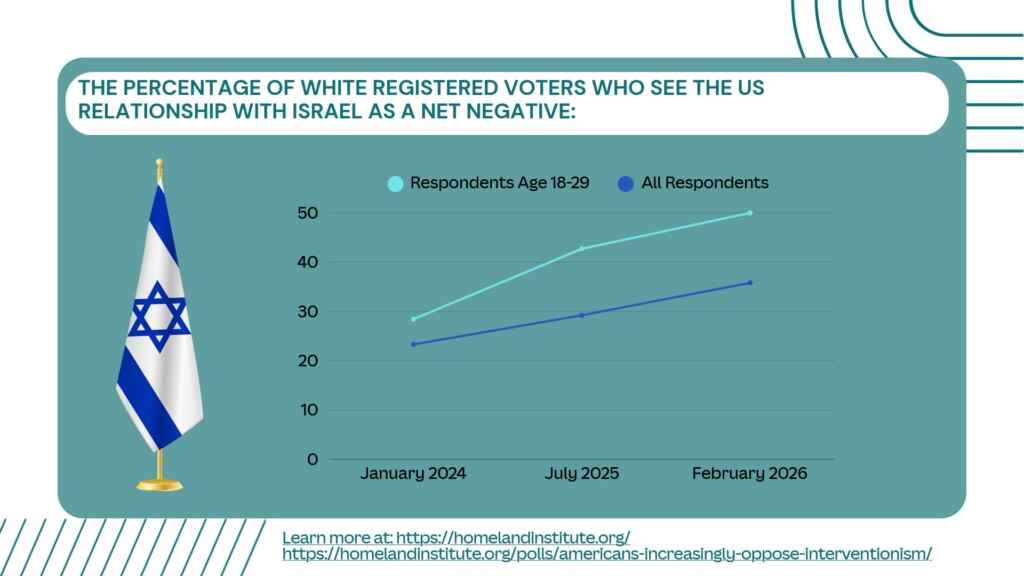 The shorter distance in time between the July 2025 and February 2026 polls (about .5 years) compared to the time between the January 2024 and July 2025 polls (1.5 years) suggests that declining support for Israel is accelerating.
A common refrain is that Israel is “our greatest friend and ally.” But 48.3% of respondents said they can think of a concrete example of Israel hurting America interests, up from 41.9% in 2025 and 29.3% in 2024. While the number of respondents who said they can think of a concrete example of Israel aiding American interests has risen to 29.3% from 26.9% in 2025 and 23.1% in 2024, this is only a slight increase.
| Q.2 Off the top of your head, can you think of a concrete example of Israel aiding American interests? | ||||
| Results by Party | ||||
| % All | Democrats | Independents | Republicans | |
| Yes | 29.3% | 19.0% | 27.5% | 40.0% |
| No | 70.7% | 81.0% | 72.5% | 60.0% |
| 18-29 | ||||
| % All | Democrats | Independents | Republicans | |
| Yes | 24.6% | 22.4% | 23.3% | 33.3% |
| No | 75.4% | 77.6% | 76.7% | 66.7% |
| Q.3 Off the top of your head, can you think of a concrete example of Israel hurting American interests? | ||||
| Results by Party | ||||
| % All | Democrats | Independents | Republicans | |
| Yes | 48.3% | 61.7% | 53.3% | 33.4% |
| No | 51.7% | 38.3% | 46.7% | 66.6% |
| 18-29 | ||||
| % All | Democrats | Independents | Republicans | |
| Yes | 56.9% | 65.3% | 55.8% | 42.4% |
| No | 43.1% | 34.7% | 44.2% | 57.6% |
2. Support for Israel
We also asked respondents their opinion on providing support to Israel in its various conflicts with economic, diplomatic and material aid, airstrikes, and troops on the ground:
| Q.4 Which of the following best describes your stance on the United States providing economic, material and diplomatic aid to Israel in various conflicts such as the Israel-Hamas War (currently under a fragile ceasefire), and the twelve-day Iran-Israel War in June, 2025? | ||||
| Results by Party | ||||
| % All | Democrats | Independents | Republicans | |
| Strongly support | 11.4% | 4.0% | 7.9% | 20.3% |
| Support | 25.2% | 16.9% | 21.8% | 35.4% |
| Neutral | 17.9% | 19.4% | 17.9% | 16.7% |
| Oppose | 19.5% | 27.0% | 19.2% | 13.1% |
| Strongly oppose | 21.1% | 27.0% | 25.3% | 11.8% |
| I don’t know | 5.0% | 5.6% | 7.9% | 2.6% |
| Q.5 Which of the following best describes your stance on United States directly intervening on behalf of Israel in various conflicts such as the Israel-Hamas War and the twelve-day Iran-Israel War with airstrikes? | ||||
| Results by Party | ||||
| % All | Democrats | Independents | Republicans | |
| Strongly support | 7.7% | 0.8% | 6.1% | 15.1% |
| Support | 20.2% | 9.3% | 17.9% | 31.8% |
| Neutral | 17.4% | 16.5% | 17.0% | 18.0% |
| Oppose | 23.1% | 29.8% | 22.7% | 18.4% |
| Strongly Oppose | 27.0% | 37.5% | 30.6% | 14.1% |
| I don’t know | 4.6% | 6.0% | 5.7% | 2.6% |
| Q.6 Which of the following best describes your stance on the United States directly intervening on behalf of Israel in various conflicts such as the Israel-Hamas War and the twelve-day Iran-Israel War with troops on the ground? | ||||
| Results by Party | ||||
| % All | Democrats | Independents | Republicans | |
| Strongly support | 5.0% | 0.8% | 3.5% | 9.8% |
| Support | 10.0% | 5.6% | 8.3% | 15.1% |
| Neutral | 14.7% | 8.9% | 14.8% | 19.3% |
| Oppose | 26.6% | 25.8% | 22.7% | 30.2% |
| Strongly Oppose | 39.7% | 54.0% | 45.0% | 23.3% |
| I don’t know | 4.0% | 4.8% | 5.7% | 2.3% |
Interestingly, the number of respondents who said they support airstrikes on behalf of Israel fell from 37% in July, 2025 to 27.9%. This decline seems to have been largely drive by Republicans, whose support for airstrikes fell from 63.3% to 46.9%.
3. The Current Israeli-Iranian Crisis
We next asked what respondents think would be the likely outcome if Trump follows through on his threats to strike Iran:
| Q.7 President Trump has threatened to strike Iran if a satisfactory deal is not reached regarding its nuclear program. Which of the following best describes what you think the ultimate end result for the United States would be if it strikes Iran? | ||||
| Results by Party | ||||
| % All | Democrats | Independents | Republicans | |
| A decisive victory | 20.5% | 4.8% | 18.8% | 35.4% |
| A moderate victory | 24.7% | 16.5% | 19.7% | 34.8% |
| A strategic stalemate, neither victory nor defeat | 28.2% | 37.1% | 31.0% | 18.4% |
| A moderate defeat | 7.2% | 13.7% | 7.4% | 2.3% |
| A decisive defeat | 6.1% | 10.5% | 7.0% | 1.6% |
| I don’t know | 13.2% | 17.3% | 16.2% | 7.5% |
The 27.5% who support striking Iran are outnumbered by the 52.2% who oppose it. Only Republicans were more supportive than opposed:
| Q.8 Which of the following best reflects your opinion on the US striking Iran? | ||||
| Results by Party | ||||
| % All | Democrats | Independents | Republicans | |
| Strongly support | 8.6% | 0.4% | 7.9% | 16.4% |
| Support | 18.9% | 5.2% | 13.1% | 34.8% |
| Neutral | 17.4% | 8.1% | 17.9% | 25.2% |
| Oppose | 24.2% | 33.5% | 27.1% | 14.1% |
| Strongly Oppose | 28.0% | 49.2% | 30.1% | 7.5% |
| I don’t know | 3.0% | 3.6% | 3.9% | 2.0% |
| 18-29 | ||||
| % All | Democrats | Independents | Republicans | |
| Strongly support | 6.2% | 0.0% | 7.0% | 15.2% |
| Support | 11.5% | 2.0% | 7.0% | 33.3% |
| Neutral | 16.2% | 10.2% | 16.3% | 24.2% |
| Oppose | 26.9% | 36.7% | 18.6% | 18.2% |
| Strongly Oppose | 34.6% | 42.9% | 46.5% | 9.1% |
| I don’t know | 4.6% | 8.2% | 4.7% | 0.0% |
Support for striking Iran was even lower among respondents age 18-29. However, there was almost very little difference in support and opposition between all Republicans and Republicans age 18-29. This could be explained by a natural tendency for the youth to like war for the sake of war which is susceptible to being hijacked. It also suggests that the youth require further education about the failed Global War on Terror.
We next explored the electoral consequences of a US strike on Iran:
| Q.9 If the US strikes Iran, will it likely be a substantial factor in whether or how you will vote in the 2026 Congressional midterm elections? | ||||
| Results by Party | ||||
| % All | Democrat | Independent | Republican | |
| Yes, I will vote Democrat when I wouldn’t have otherwise | 3.4% | 4.0% | 6.1% | 1.0% |
| Yes, I will vote for a third-party or write in candidate when I wouldn’t have otherwise | 2.0% | 0.4% | 3.9% | 1.6% |
| Yes, I will not vote at all when I would have otherwise voted | 1.1% | 0.0% | 2.6% | 1.0% |
| Yes, I will vote Republican when I wouldn’t have otherwise | 1.7% | 0.0% | 0.9% | 3.9% |
| No, it will not change whether or how I will vote | 80.6% | 89.1% | 64.6% | 85.6% |
| I don’t know/undecided | 11.1% | 6.5% | 21.8% | 6.9% |
| 18-29 | ||||
| % All | Democrat | Independent | Republican | |
| Yes, I will vote Democrat when I wouldn’t have otherwise | 6.2% | 6.1% | 9.3% | 3.0% |
| Yes, I will vote for a third-party or write in candidate when I wouldn’t have otherwise | 3.8% | 2.0% | 7.0% | 3.0% |
| Yes, I will not vote at all when I would have otherwise voted | 3.8% | 0.0% | 7.0% | 6.1% |
| Yes, I will vote Republican when I wouldn’t have otherwise | 1.5% | 0.0% | 0.0% | 6.1% |
| No, it will not change whether or how I will vote | 71.5% | 83.7% | 53.5% | 72.7% |
| I don’t know/undecided | 13.1% | 8.2% | 23.3% | 9.1% |
Based on adding together those who claim they will vote Democrat, for a third party or write in candidate, or not at all when they wouldn’t have otherwise, and then subtracting those who will vote Republican when they wouldn’t have otherwise, a US strike on Iran could cost Republicans 4.7% of the vote in the midterms. Among respondents age 18-29, that number is 13.8%.
4. Striking Iran Compared to Specific Issues
Voters saw a number of other issues as more important than the Israeli-Iranian and related conflicts:
| Q.10 Compared to the Israeli-Iranian and related conflicts, how important is conducting mass deportations? | ||||
| Results by Party | ||||
| % All | Democrats | Independents | Republicans | |
| Much more important | 19.5% | 3.6% | 19.7% | 32.8% |
| More important | 18.1% | 6.0% | 17.5% | 29.5% |
| About the same importance | 15.6% | 6.9% | 14.8% | 23.3% |
| Less important | 12.6% | 16.5% | 14.4% | 8.2% |
| Much less important | 17.5% | 35.9% | 15.7% | 3.3% |
| I oppose or don’t care about either | 14.2% | 28.2% | 14.4% | 1.6% |
| I don’t know | 2.5% | 2.8% | 3.5% | 1.3% |
| Q.11 Compared to the Israeli-Iranian and related conflicts, how important is the stock market? | ||||
| Results by Party | ||||
| % All | Democrats | Independents | Republicans | |
| Much more important | 14.0% | 9.3% | 14.0% | 17.0% |
| More important | 31.1% | 27.0% | 34.9% | 32.5% |
| About the same importance | 18.1% | 14.5% | 15.7% | 23.6% |
| Less important | 16.9% | 22.6% | 11.4% | 16.4% |
| Much less important | 10.4% | 15.3% | 10.5% | 5.9% |
| I oppose or don’t care about either | 3.9% | 5.2% | 5.2% | 0.7% |
| I don’t know | 5.7% | 6.0% | 8.3% | 3.9% |
| Q.12 Compared to the Israeli-Iranian and related conflicts, how important is affordable housing? | ||||
| Results by Party | ||||
| % All | Democrats | Independents | Republicans | |
| Much more important | 40.2% | 48.8% | 51.1% | 23.9% |
| More important | 32.3% | 35.1% | 30.6% | 31.1% |
| About the same importance | 14.1% | 9.7% | 8.3% | 22.6% |
| Less important | 7.6% | 3.6% | 5.7% | 12.8% |
| Much less important | 3.9% | 1.6% | 3.1% | 6.6% |
| I oppose or don’t care about either | 0.9% | 0.4% | 0.4% | 1.6% |
| I don’t know | 1.0% | 0.8% | 0.9% | 1.3% |
| Q.13 Compared to the Israeli-Iranian and related conflicts, how important is reducing unemployment? | ||||
| Results by Party | ||||
| % All | Democrats | Independents | Republicans | |
| Much more important | 33.5% | 39.5% | 43.7% | 19.7% |
| More important | 37.5% | 38.7% | 36.7% | 37.4% |
| About the same importance | 16.0% | 12.9% | 10.0% | 23.3% |
| Less important | 8.6% | 6.5% | 3.9% | 14.4% |
| Much less important | 2.9% | 1.6% | 3.5% | 3.3% |
| I oppose or don’t care about either | 0.5% | 0.0% | 0.9% | 0.7% |
| I don’t know | 1.1% | 0.8% | 1.3% | 1.3% |
| Q.14 Compared to the Israeli-Iranian and related conflicts, how important is student loan forgiveness? | ||||
| Results by Party | ||||
| % All | Democrats | Independents | Republicans | |
| Much more important | 16.0% | 25.8% | 19.7% | 4.6% |
| More important | 18.1% | 29.4% | 21.0% | 6.9% |
| About the same importance | 9.4% | 10.9% | 7.9% | 8.5% |
| Less important | 16.1% | 17.7% | 12.2% | 18.4% |
| Much less important | 27.6% | 10.1% | 24.9% | 44.9% |
| I oppose or don’t care about either | 9.2% | 2.0% | 10.9% | 13.1% |
| I don’t know | 3.6% | 4.0% | 3.5% | 3.6% |
| Q.15 Compared to the Israeli-Iranian and related conflicts, how important is cryptocurrency? | ||||
| Results by Party | ||||
| % All | Democrats | Independents | Republicans | |
| Much more important | 3.6% | 1.2% | 5.2% | 4.3% |
| More important | 5.6% | 4.0% | 8.3% | 5.2% |
| About the same importance | 8.1% | 5.2% | 7.0% | 11.8% |
| Less important | 17.9% | 16.9% | 17.9% | 19.3% |
| Much less important | 45.6% | 49.6% | 41.0% | 45.6% |
| I oppose or don’t care about either | 13.4% | 16.9% | 14.0% | 8.5% |
| I don’t know | 5.9% | 6.0% | 6.6% | 5.2% |
| Q.16 Compared to the Israeli-Iranian and related conflicts, how important is investigating the Epstein files? | ||||
| Results by Party | ||||
| % All | Democrats | Independents | Republicans | |
| Much more important | 32.7% | 48.8% | 41.9% | 12.1% |
| More important | 18.0% | 23.4% | 17.5% | 14.1% |
| About the same importance | 15.9% | 14.9% | 13.1% | 18.7% |
| Less important | 11.6% | 6.5% | 9.6% | 17.0% |
| Much less important | 16.2% | 3.6% | 14.4% | 28.5% |
| I oppose or don’t care about either | 3.0% | 0.8% | 1.7% | 5.9% |
| I don’t know | 2.6% | 2.0% | 1.7% | 3.6% |
72.5% of respondents considered affordable housing to be more important than the Israeli-Iranian and related conflicts, and 71% reducing unemployment as more important.
That number was 50.7% for investigating the Epstein files, 45.1% for the stock market, 37.6% for deportations, 34.1% for student loan forgiveness, and 9.2% for cryptocurrency,
5. Foreign Policy in General
We next asked respondents which areas of the world they would like US foreign policy to encompass:
| Q.17 Which of the following would you like America foreign policy to generally encompass? Pick all that apply. | ||||
| Results by Party | ||||
| % All | Democrats | Independents | Republicans | |
| Africa | 28.8% | 36.3% | 33.2% | 19.7% |
| Antarctica (south pole) | 20.5% | 20.6% | 25.3% | 16.7% |
| The Arctic (north pole) | 25.1% | 23.8% | 31.0% | 21.6% |
| East Asia | 34.7% | 44.0% | 35.4% | 26.9% |
| Europe | 49.7% | 59.3% | 51.1% | 41.6% |
| Latin America | 42.1% | 46.8% | 45.9% | 36.4% |
| The Middle East | 36.7% | 40.7% | 36.2% | 34.4% |
| North America | 70.7% | 71.4% | 72.9% | 69.8% |
| None of the above | 18.4% | 17.7% | 18.3% | 17.7% |
There was a paradox in which Republicans were more isolationist in the number of regions they picked, including the Middle East, despite having higher support for Israel and a strike on Iran. Interesting, Europe was the second most popular option at 49.7% after North America at 70.7%.
Finally, we asked respondents whether they think foreign intervention is positive or negative for both Americans and foreigners:
| Q.19 Regarding the interests of the American people, do you think that intervention in foreign countries by the United States government is generally: | ||||
| Results by Party | ||||
| % All | Democrats | Independents | Republicans | |
| A major net positive | 5.2% | 3.3% | 4.1% | 8.5% |
| A minor net positive | 18.1% | 14.2% | 14.2% | 26.8% |
| About equally positive and negative | 21.2% | 22.5% | 19.6% | 23.7% |
| A minor net negative | 22.6% | 23.8% | 24.2% | 23.4% |
| A major net negative | 29.3% | 36.3% | 37.9% | 17.6% |
| I don’t know | 3.5% | 3.3% | 4.6% | 3.4% |
| Q.20 Regarding the interests of foreign peoples, do you think that intervention in foreign countries by the United States government is generally: | ||||
| Results by Party | ||||
| % All | Democrats | Independents | Republicans | |
| A major net positive | 12.5% | 8.7% | 11.2% | 18.5% |
| A minor net positive | 20.1% | 15.4% | 19.2% | 28.1% |
| About equally positive and negative | 23.0% | 21.6% | 24.3% | 26.7% |
| A minor net negative | 15.9% | 20.7% | 16.8% | 13.0% |
| A major net negative | 24.2% | 33.6% | 28.5% | 13.7% |
| I don’t know | 4.4% | 2.9% | 7.0% | 4.5% |
As in the July 2025 poll, more respondents believe that foreign intervention is a net negative than a net positive for foreign peoples. This trend was even more pronounced for the American people.
6. Conclusion
- More respondents now say that the US relationship with Israel is a net negative than a net positive. Declining support for Israel is likely accelerating.
- Age is almost as strong a factor in declining support for Israel as party affiliation.
- The number of respondents who said they support airstrikes on behalf of Israel fell from 37% in July, 2025 to 27.9%, mostly driven by a drop in support among Republicans.
- A US strike on Iran could cost Republicans 4.7% of the white vote in the midterms, including 13.8% of white voters age 18-29.
- The 27.5% who support striking Iran are outnumbered by the 52.2% who oppose it.
- Young Republicans are at risk of having their natural aggression hijacked for nefarious purposes. This suggests that the youth require further education on the failed Global War on Terror.
- Over 70% of respondents consider affordable housing and reducing unemployment as more important than the Israeli-Iranian and related conflicts.
- 7% consider investigating the Epstein files to be more important than the Israeli-Iranian conflict, as do 45.1% for the stock market.
- When asked what regions respondents would like US foreign policy to encompass, Europe was the second most popular option after North America.
- Republicans would like US foreign policy to encompass fewer regions than Independents and Democrats despite having higher support for Israel and striking Iran.
- More respondents believe that foreign intervention is a net negative than a net positive for foreign peoples, and even more so for the American people.